
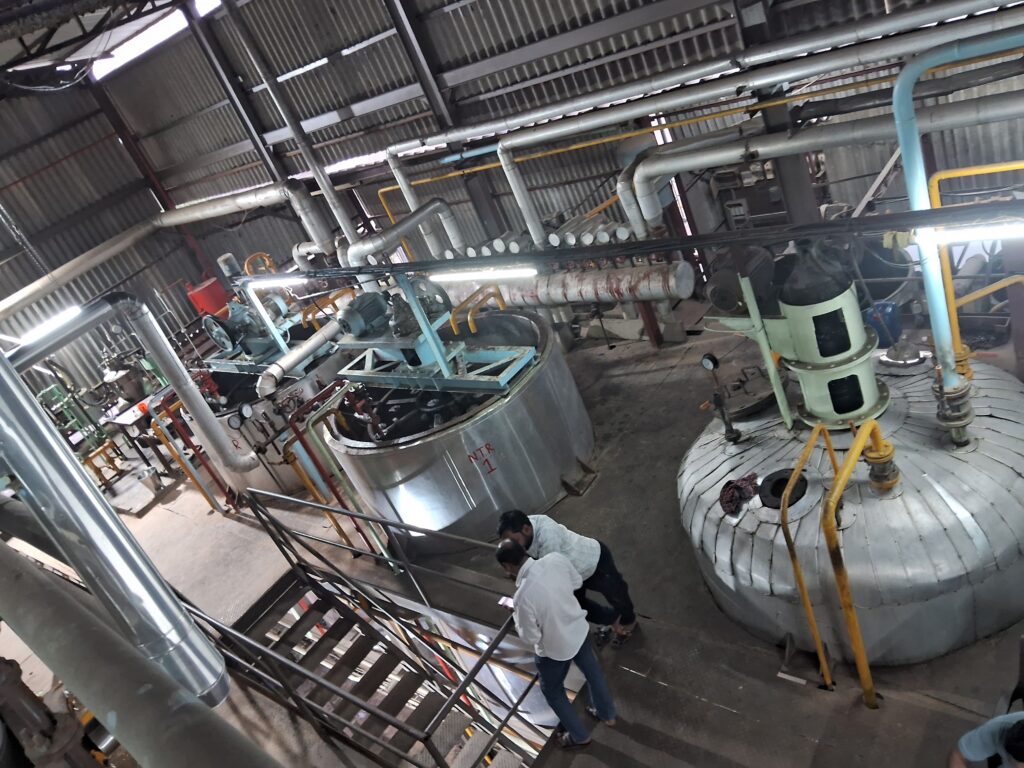
Neutralizing
A refining process is carried out following extraction of crude edible oils by means of screw presses and / or solvent extraction.
In refining, physical and chemicals processes are combined to remove undesirable natural as well as environmental-related components from the crude oil.
These components comprise for example phosphatides, free fatty acids, pigments (such as chlorophyll,) odors and flavors (including aliphatic aldehyde and ketone), waxes as well as heavy metals, pesticides etc.
Depending on the requirements, the following basic processes are implemented:
- Degumming for removal of phosphatides,
- neutralization for removal of tree fatty acids,
- bleaching for removal of color,
- deodorization to distill odors and flavors as well as free fatty acids and
- winterization for separation of waxes.
Refined edible oils are either directly used for human nutrition or serve as feed stock for further processing for example, for mayonnaise, margarine, shortening and for the production of biodiesel. Important process steps in this context are fractionation, hardening and interesterification.
SPARKTECH offers customized machine solutions for any application or process to meet the individual requirements of the customers.
Different degumming processes are carried out to remove phosphatides. For efficient and economic application of this procedure
SPARKTECH provides appropriate machines and equipments.
Water degumming
A large part of the phosphatides (gums) cab be hydrated quickly and easily. If the pressed or extracted oil contains a considerable quantity of gums the oil is subjected to the water degumming process immediately following extraction. In this process, water is added to the oil. After a certain reaction period the hydrated phosphatides can be separated either by decantation (settiling) or continuously by means of centrifuges.
In this process step a large part of hydratable and even a small proportion of the non-hydratable phophatides are removed.
The extracted gums can be processed into lecithin for food, feed or technical purposes.
The gum content in the oil is subsequently reduced according to the refining quality requirements. In principle, the combination and concept of further processing stages in distinguished by
chemical refining and • physical refining.
In chemical refining the free fatty acids are neutralized by caustic soda resulting so-called “soap stock” which is also separated either by decantation or continuously by means of centrifuges.
Simultaneously the non-hydratable phosphatides are also separated in this process.
In physical refining the gum content can be further reduced by different processes:
Dry acid degumming or • wet acid degumming.