
Complete Refining Solutions
Vegetable Oil Refineries
We design and engineer both chemical and physical refining plants tailored to the specific oil type, feedstock quality, and end-product requirements of our clients. Refining is one of the most critical stages in vegetable oil processing — it determines the final quality, stability, taste, and shelf life of the oil — and our plants are engineered to deliver consistent, high-purity and good quality product.
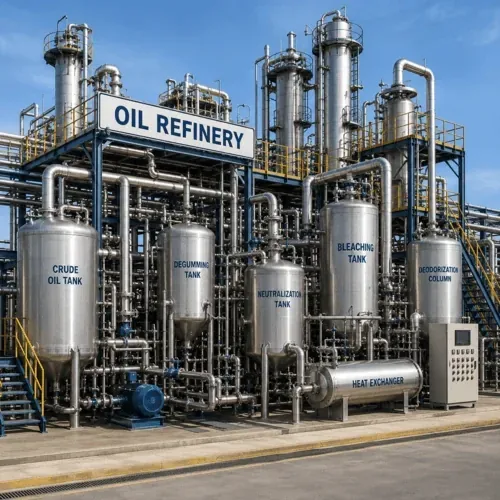
Neutralizing & Refining
A refining process is carried out following extraction of crude edible oils by means of screw presses and/or solvent extraction.
In refining, physical and chemical processes are combined to remove undesirable natural as well as environmental-related components from the crude oil including phosphatides, free fatty acids, pigments (such as chlorophyll), odors and flavors, waxes, heavy metals, pesticides etc.
Basic Processes: Degumming for removal of phosphatides, neutralization for removal of free fatty acids, bleaching for removal of color, deodorization to distill odors and flavors as well as free fatty acids, and winterization for separation of waxes.
Degumming Process
Water Degumming: A large part of the phosphatides (gums) can be hydrated quickly and easily. Water is added to the oil and after a certain reaction period the hydrated phosphatides can be separated either by decantation (settling) or continuously by means of centrifuges.
A large part of hydratable and even a small proportion of the non-hydratable phosphatides are removed. The extracted gums can be processed into lecithin for food, feed or technical purposes.
Chemical Refining: The free fatty acids are neutralized by caustic soda resulting in so-called soap stock which is separated. Simultaneously the non-hydratable phosphatides are also separated.
Physical Refining: The gum content can be further reduced by dry acid degumming or wet acid degumming processes.
Dry & Wet Acid Degumming
Dry Acid Degumming: Particularly suitable for oils with low gum contents such as palm oil, coconut oil, palm kernel oil or animal fats. Intensive mixing is implemented following addition of acid to pre-heated crude oil. Conditioned gums are absorbed into bleaching earth and separated by filtration.
Benefits: Low energy consumption, low operation and maintenance costs, minimum footprint, low investment costs, environmentally friendly as no wastewater or soap stock occur.
Wet Acid Degumming: Initially oils with higher gum contents (e.g. corn oil) are similarly processed. Water is added following acid apportioning to achieve gum hydration. Centrifuges enable easy separation of gums in oils with higher non-hydratable gum contents. Consumption of bleaching earth is reduced because the oil has already been extensively degummed.
Bleaching
Continuous bleaching process used for: bleaching degummed oil prior to physical neutralization and deodorization, bleaching wet-degummed and chemically neutralized oil prior to deodorization, and post-refining of hydrogenated and chemically interesterified oils and fats.
The loop reactor enables operation without agitator tanks as well as simultaneous intensive mixture and contact of the bleaching earth with the oil. The bleaching earth adsorbs color pigments as well as oxidation-supporting metal ions, complex compounds, residual soaps and traces of catalyst from hydrogenation.
Benefits: Enhanced product quality, gentle heating through optimized temperature control, intensive decoloration, increased efficiency through optimized utilization of bleaching earth in loop reactor, energy efficiency, and higher wear resistance through high quality materials.
De-Waxing
For bottled edible oils (e.g. sunflower seed oil or corn oil), winterization prevents crystallization & clouding of waxes at ambient temperature. Oil is cooled by heat exchange with cold water to 5-10 degree C. Crystals are formed during maturation period of up to 24 hours & subsequently separated through horizontal filters.
Deodorization
The continuous deodorizer operates according to the counter current principle. In case of higher concentration of fatty acids, an upstream counter current column is connected. This ensures optimal absorbing capacity of stripping steam resulting in considerable savings.
Gentle cooling under deodorizing conditions, uniform processing, integrated counter current heat transfer with high heat recovery (>80%), long service life, no moving parts, compact configuration with integrated vapour scrubber, easy inspection and product change.
Key Features & Benefits
- Fully automated handling of various crude oil qualities
- Short downtime for raw material changeover
- Best centrifugal separators for high yields
- Centralized control system operation
- Loop reactor for continuous bleaching
- High vacuum deodorization system
- Heat recovery exceeding 80%
- Continuous and semi-continuous operation